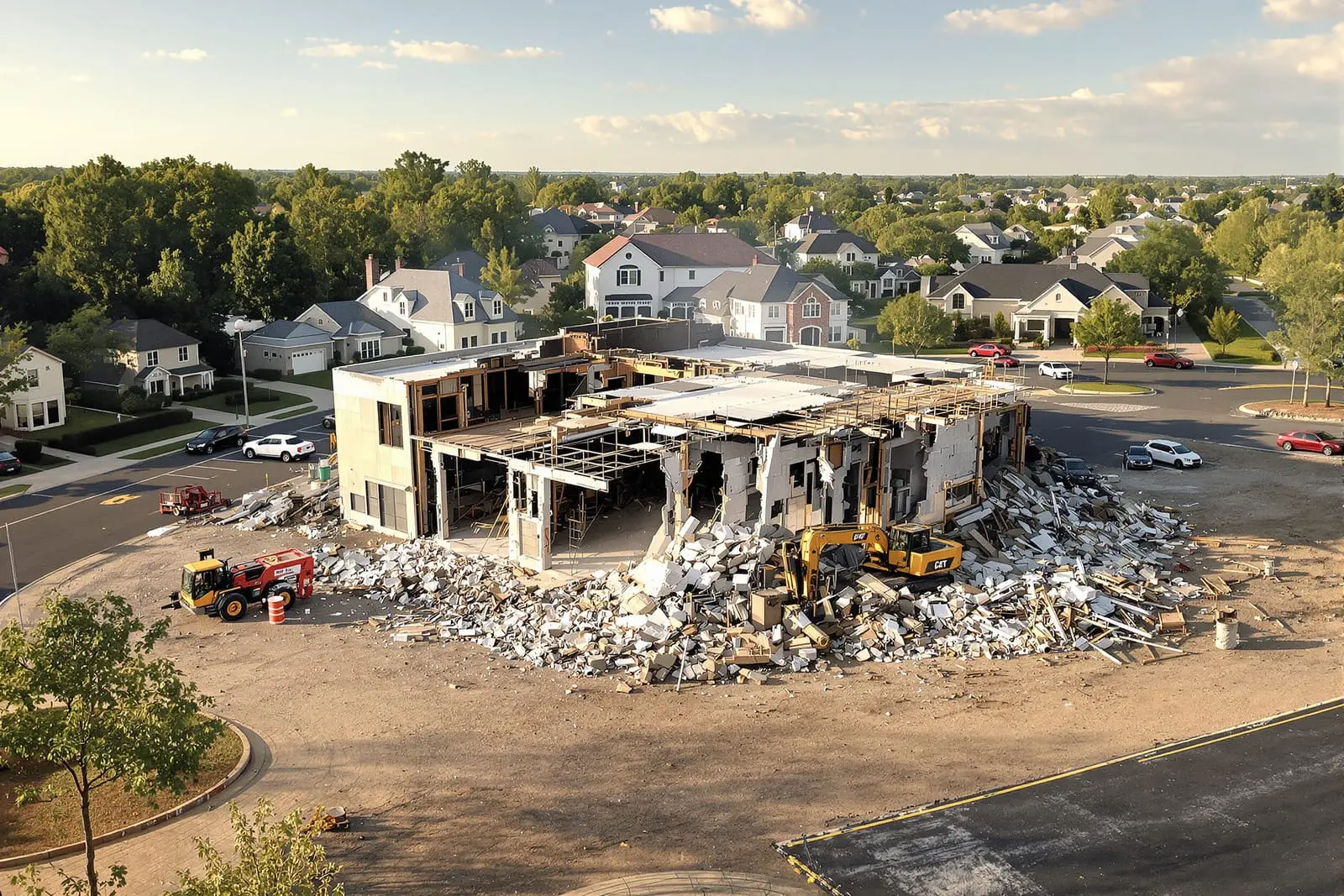
Wrexo Demolition Raleigh coordinates implosion demolition in Raleigh, NC for structures where conventional methods are not practical. Working with licensed blasting engineers, we plan charge placement, safety perimeters, and debris zones. Communication with authorities and neighbors is central to each project. Our team ensures explosive demolitions are executed safely and precisely.
Wrexo Demolition Raleigh provides professional implosion demolition throughout Raleigh, NC and the surrounding area. Our licensed, insured crew delivers safe, clean, on-time work with a free estimate before anything begins. Call (984) 254-6930 or request your free quote.
Explosive and Implosion Demolition in Raleigh, NC
Explosive and implosion demolition is a specialized solution for taking down large, complex structures in tight spaces. In the Triangle, this most often applies to aging mid-rise office buildings, industrial facilities, parking decks, and reinforced concrete structures where mechanical demolition alone would be slow, disruptive, or unsafe.
Wrexo Demolition Raleigh focuses on engineered explosive work that brings a structure down in a controlled manner, not just “blowing it up.” We evaluate the building, load paths, and surrounding environment so the structure collapses inward on a planned footprint. This is especially important in Raleigh’s mixed-use corridors, where old industrial properties are being redeveloped next to occupied apartments, medical offices, and historic neighborhoods.
If you are considering implosion demolition, you should know it is highly regulated, deeply engineered, and planned weeks or months in advance. Our role is to make that process predictable for you, so you understand what will happen, when it will happen, and how risks are managed before any explosive is brought on site.
How Implosion Demolition Actually Works
Effective implosion demolition starts with understanding how the building stands up. Our engineers review structural drawings when available, then verify them with site investigations. We map columns, shear walls, transfer beams, and floor systems, and identify the primary vertical and lateral load paths. For many Raleigh structures built in the 1960s through 1990s, that means concrete frames with pan joist floors or structural steel frames with concrete on metal deck.
Next, we model how the structure will behave when critical supports are removed. The objective is not to destroy every element with explosives. Instead, we selectively weaken and cut columns, beams, and connection points so gravity does the rest. Charges are placed on specific members at specific elevations in a timed sequence that makes the building fold into itself.
We typically use shaped charges on reinforced concrete columns and linear charges on steel members. Each charge is sized to the cross section and reinforcement pattern, and is wrapped or tamped so energy is directed into the structural member, not into the surrounding environment. Non-electric or electronic detonators control the firing sequence down to milliseconds, which is how we “steer” the way the building falls.
On the week of the implosion, preparation work is usually more extensive than the blast itself. We pre-cut or score concrete, remove non-structural elements that could fly, and install blast mats or geotextiles at key locations. Protective measures around utilities, glass on adjacent buildings, and sensitive equipment are completed before any final checks or test shots.
Planning, Permits, and Regulatory Oversight in Raleigh
Implosion demolition in Raleigh requires close coordination with local and state authorities. Wrexo Demolition Raleigh manages this process so owners and developers are not navigating it alone.
First, we complete a detailed demolition plan that covers structural methodology, explosive types and quantities, anticipated vibration levels, dust control methods, traffic management, and emergency procedures. This plan is submitted to the City of Raleigh, the local fire marshal, and if required, state agencies such as the North Carolina Department of Environmental Quality for environmental considerations.
All explosive work in North Carolina must adhere to federal ATF regulations and OSHA standards. Our licensed blasters maintain current credentials, and we document explosive inventory from transport to final shot. For downtown or higher profile projects, coordination meetings with police, EMS, and nearby property managers are standard. These meetings define road closures, detour routes, safety perimeters, and building access restrictions on blast day.
Because many Raleigh buildings contain asbestos, lead-based paint, or PCB-laden materials, environmental abatement is often a prerequisite to any explosive use. We work with certified abatement contractors or your chosen firm to ensure regulated materials are removed or properly contained so the implosion does not disperse hazardous dust. Without this step, permits for implosion demolition are unlikely to be approved.
Site Assessment and Protecting Neighboring Properties
Not every structure in Raleigh qualifies for implosion demolition, and not every site can safely accommodate it. Our first step is a feasibility assessment that weighs structural suitability, site constraints, and neighborhood sensitivities.
We survey distances to adjacent buildings, critical utilities, and infrastructure such as NCDOT roadways, rail lines, and transmission corridors. In areas like Glenwood South, Warehouse District, or near active hospitals and campuses, clearances can be extremely tight. In those cases, we may recommend a hybrid approach, with conventional mechanical demolition on perimeter sections and implosion reserved for the core.
Pre-implosion, we perform building condition surveys on nearby structures. This involves photographing and documenting existing cracks in walls, slabs, or finishes. Vibration monitoring units are installed on agreed locations so we can track peak particle velocities against safe thresholds. This documentation protects both you and neighboring owners by clarifying what existed before the blast.
We also plan exclusion zones and viewing areas. Residents, businesses, and traffic within a defined perimeter are controlled or temporarily evacuated based on the blast plan. For multi-tenant buildings and campuses, Wrexo Demolition Raleigh helps coordinate notices, access restrictions, and re-entry timing so disruption is kept to a predictable minimum.
Cost Drivers and Budgeting for Implosion Demolition
Explosive and implosion demolition is not automatically the cheapest option. It is most cost effective when time savings and reduced mechanical work offset the extensive planning and specialty labor involved. We are transparent about when it makes financial sense and when it does not.
Major cost drivers include building size and height, structural system, level of interior finishes, complexity of the surrounding environment, and required environmental abatement. A simple concrete-frame parking deck surrounded by open land is far less complex than a mixed-use tower flanked by occupied condominiums and historic brick facades.
Engineering and blast design hours form a significant portion of the budget. So do vibration monitoring, pre-blast surveys, and the traffic control or police presence that Raleigh may require for road closures. Explosive materials themselves are usually a smaller fraction than clients expect; the expertise and safeguards to use them properly are what drive most of the implosion-specific costs.
During pre-construction, Wrexo Demolition Raleigh provides scenario-based pricing. For example, we will compare a pure mechanical takedown with an implosion-assisted approach that uses explosives to drop the main structure, then uses excavators and processors for debris management. This helps you evaluate schedule compression against added planning expense, especially when your redevelopment timeline, financing, or lease turnover dates put pressure on the schedule.
Safety, Risk Management, and Common Concerns
Safety is non-negotiable in explosive demolition. Our planning focuses on four primary risk categories: fly rock and debris, vibration impact, dust and air quality, and misfire or unexpected structural behavior.
Fly debris is controlled through careful selection of target members, charge sizing, placement, and containment. We use blast mats, geo-textile wraps, and in some cases, pre-demolition removal of exterior panels or glazing that might become projectiles. Structural pre weakening is done so gravity pulls materials inward instead of outward.
For vibration, we model predicted levels based on charge weight per delay, distance to structures, and local soil conditions. Much of Raleigh sits on variable Piedmont soils with transitions from saprolite to rock. We adjust charge weights and sequencing to keep predicted peak particle velocity below thresholds known to protect typical residential and commercial construction.
Dust management includes pre-wetting structures, real-time water misting, and considering prevailing winds. On blast day, air monitoring can be implemented for sensitive sites such as near medical facilities or schools. Public communication is crucial; we prepare straightforward information for tenants and neighbors that explains what they will see and hear, and for how long.
Misfire risk is minimized with redundant checks of firing lines, controlled access, and strict blast area security. Electronic initiation systems with comprehensive diagnostics reduce uncertainty, and we maintain pre established abort and contingency procedures in case any parameter falls outside the plan prior to firing.
Is Implosion Demolition Right for Your Raleigh Project
Implosion demolition is typically worth considering in Raleigh when you have a mid to high rise structure or a heavily built industrial facility, limited site access for large mechanical equipment, and a schedule that benefits from taking the building down in seconds rather than weeks of top down mechanical work.
Good candidates include obsolete office towers slated for mixed use redevelopment, aging hospital or campus buildings with robust concrete or steel frames, and decommissioned industrial sites where thick concrete and heavy steel would be extremely time consuming to dismantle with excavators alone. Less suitable candidates might be smaller masonry structures, wood frame buildings, or sites with utilities and historic structures too close to safely tolerate vibration.
Wrexo Demolition Raleigh will not recommend explosives just because we can perform them. Our process starts with a feasibility review, a comparison to high reach and mechanical alternatives, and a clear explanation of risk, cost, permitting expectations, and schedule implications for your specific parcel.
If implosion demolition is the right tool, we guide you from early due diligence and budgeting through permit approval, blast day execution, and post blast cleanup and backfill. If another method is safer, more economical, or more compatible with neighborhood concerns, we will say so and propose a better alternative.
“
Professional explosive and implosion demolition, done right the first time, quality materials, honest pricing, and results that last.
Wrexo Demolition Raleigh
Explosive and Implosion Demolition Across Our Service Area