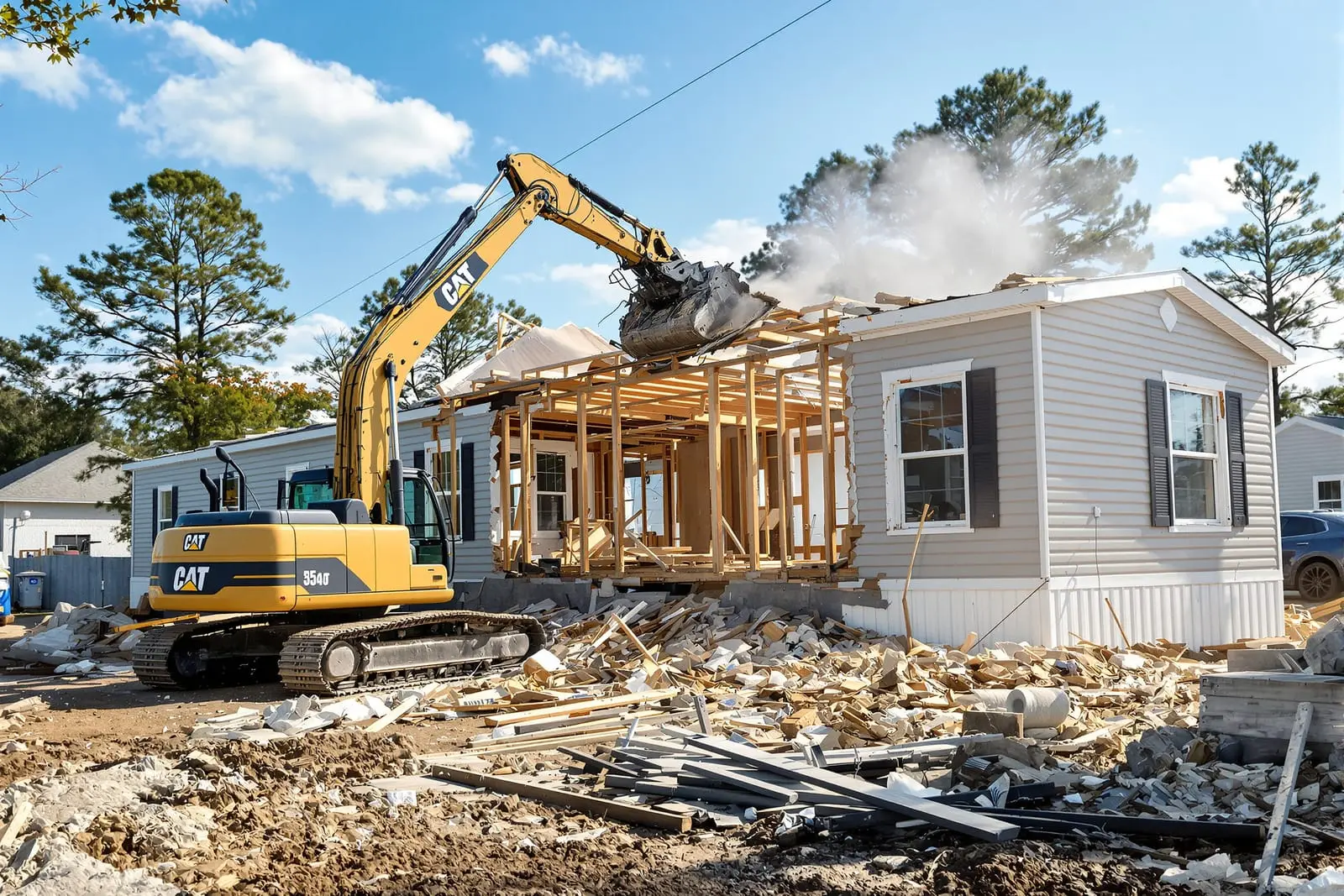
Home › Mobile Home and Manufactured Home Demolition
Wrexo Demolition Raleigh offers mobile home demolition services in Raleigh, NC for parks, private lots, and rural properties. We disconnect utilities, dismantle or demolish the structure, and remove frames, skirting, and piers. Our crew then levels and cleans the site so it is ready for new use. Count on us for fast, code compliant mobile and manufactured home removal.
Wrexo Demolition Raleigh provides professional mobile home demolition throughout Raleigh, NC and the surrounding area. Our licensed, insured crew delivers safe, clean, on-time work with a free estimate before anything begins. Call (984) 254-6930 or request your free quote.
Mobile Home Demolition Specialists in Raleigh, NC
Mobile and manufactured home demolition is a focused service that demands more than just heavy equipment. At Wrexo Demolition Raleigh, we approach every project as a combination of structural work, permitting, utility safety, and debris handling that fits Wake County rules and your specific site conditions.
In the Raleigh area, mobile homes range from older single-wides on rural lots to newer double-wides in organized communities. Each setup is different. Some are on concrete block piers with tie-downs, others are on poured slabs or crawlspace footings, and some still have intact axles and frames. Our crews inspect these details first, because they determine how we separate the structure from utilities, how we section the home for demolition, and how we load and haul materials.
Wrexo Demolition Raleigh is fully insured and operates with crews that do this type of work every week. We are used to tight access, nearby neighbors, HOA rules, and shared driveways common in and around Raleigh. Before we start, you know exactly what will be removed, what will remain, and what your lot will look like when we are finished.
How Our Mobile Home Demolition Process Works
Our process is built to be predictable and transparent for homeowners, property managers, and investors.
1) Site visit and assessment: We begin with an on-site evaluation in Raleigh or the surrounding towns. We document the size and type of home (single-wide, double-wide, triple-wide), the foundation style, attached additions such as decks, porches, awnings, carports, and sheds, and the surrounding features like wells, septic systems, trees, or fences that must be preserved.
2) Utility coordination: Before any demolition starts, all utilities must be safely disconnected or capped. We verify electrical service at the pole or meter, water (city supply or well), sewer or septic, natural gas or propane, and any cable or phone lines. If the owner has not already scheduled disconnects, Wrexo Demolition Raleigh can coordinate with the appropriate providers or licensed subcontractors so you are not stuck making multiple calls.
3) Permitting and compliance: In Raleigh and Wake County, demolition permits are typically required, even for manufactured homes. We handle the permit paperwork when requested, including providing proof of utility disconnects and any required site plan. We build our schedule around city or county review times so there are no surprises.
4) Demolition and removal: Once the home is cleared and permitted, we bring the appropriate machines, usually a compact excavator or small tracked loader for tighter mobile home parks and a larger excavator for rural parcels. We strip out salvageable metals first when possible, such as steel frames and copper, then mechanically deconstruct the structure into manageable sections. Materials are then loaded into roll-off containers or trucks for disposal or recycling.
5) Final grading and cleanup: After the structure is gone, we remove piers, tie-downs, skirting, loose debris, and most surface-level obstacles. If requested, we can remove the concrete pad or footings as a separate item. We rough grade the area so it drains properly and is ready for your next step, whether that is a new home, a shop, or simple open space.
What Drives the Cost of Mobile Home Demolition
Mobile home demolition pricing in Raleigh is influenced by several concrete factors, not guesses or flat quotes pulled out of thin air. Understanding these will help you compare bids intelligently.
Size and type of home: A small single-wide costs less than a large double-wide or multiple units on the same lot. Longer and wider structures generate more debris and require more machine time and hauling.
Foundation and substructures: Homes on simple block piers with skirting generally cost less to remove than those on full concrete slabs or permanent block foundations. If you want the slab, footings, or masonry removed, that adds labor, machine time, and disposal volume.
Additions and accessory structures: Decks, attached porches, enclosed rooms, carports, and lean-tos can add significant complexity. Some of these are framed differently from the original home and must be taken down in a specific order to stay safe. We itemize these so you can decide what stays and what goes.
Hazardous or special materials: Many older manufactured homes in the Raleigh region contain components that may need special handling, such as asbestos in floor tiles or mastic, certain ceiling panels, or older duct tape products. If we suspect regulated materials, we will recommend testing before demolition. Any abatement or special disposal is clearly identified in our estimate rather than hidden.
Site access and haul distance: Narrow park roads, difficult driveways, and steep or wet yards can slow production and may dictate smaller equipment or smaller loads. Distance to the nearest approved disposal or recycling facility also contributes to total cost. Since disposal fees in Wake County and neighboring counties are a significant portion of any demolition budget, we design our approach to limit wasted trips.
Mobile Home Demolition vs. Relocation or Deconstruction
Raleigh property owners often ask whether a mobile home should be demolished, moved, or partially salvaged. Wrexo Demolition Raleigh walks you through realistic options before you commit.
Relocation: Moving a manufactured home is only practical if the structure is relatively modern, intact, and was originally designed for transport. Many older units have water damage, frame rust, roof leaks, or obsolete wiring and plumbing that make moving unsafe or cost-prohibitive. In many cases, the axles, wheels, and tongues have been removed or deteriorated, which raises reinstallation costs.
Partial deconstruction: Sometimes owners want to salvage specific items such as HVAC units, newer appliances, cabinets, or doors. We can schedule a short salvage window for you or your contractors before we mobilize machines, as long as it does not compromise structural stability. For certain homes, especially those with valuable metal frames or newer components, we can integrate material salvage into our workflow to offset some of the cost.
Full mechanical demolition: When structures are at the end of their life, have been vandalized, or have significant mold or rodent contamination, full demolition is usually the best solution. It eliminates hidden hazards on your lot and clears the way for a cleaner build. We explain why we recommend demolition in plain terms, backed by photos and observations from the site walk.
Local Conditions and Scheduling in the Raleigh Area
Climate and local site conditions around Raleigh matter for mobile home demolition work. Our humid summers, clay-heavy soils, and frequent rain events affect both timing and equipment choices.
Weather and seasonality: In summer, afternoon thunderstorms are common. We schedule work blocks to avoid leaving partially demolished structures exposed overnight whenever possible, which reduces mess and safety risks. During wetter seasons, particularly late winter and early spring, saturated ground can limit heavy equipment access. When needed, we bring track machines that distribute weight better and plan temporary access paths so we do not tear up your yard more than necessary.
Soil and drainage: Many manufactured homes around Raleigh sit on lots with red clay that holds water. When we remove the structure and any concrete, we look at how water currently drains across the site. If demolition exposes low spots or directs runoff toward neighboring properties or your foundation, we can perform basic grading to restore positive drainage, which prevents standing water and future erosion.
Neighbor and community considerations: In tighter parks and subdivisions, noise windows, parking, and access must be managed carefully. Wrexo Demolition Raleigh coordinates with property managers, HOAs, or neighbors when needed to set work hours, maintain emergency access, and keep roads clear for trash and mail. Clear communication ahead of time minimizes friction and keeps your project from being delayed by complaints.
Permits, Utilities, and Code Compliance
Raleigh and Wake County have specific expectations for mobile home and manufactured home demolition, and ignoring them can lead to fines or project delays. We help you avoid those problems by dealing with them upfront.
Permits: Depending on where your property is located, you may need a demolition permit from the City of Raleigh or from the county. We clarify which jurisdiction applies, prepare or assist with the application, and provide any documentation the building department needs, such as a basic site sketch, proof of ownership, and utility disconnect letters.
Utility verification: It is not enough to simply turn off breakers inside the home. Power must be disconnected at the meter or pole, water must be shut off at the street or well head, and gas or propane service must be locked or removed by the provider. We visually verify each point of service before equipment starts. If underground lines cross areas of planned excavation, we request utility locates so we do not hit unknown services.
Disposal and environmental responsibility: Disposal facilities around Raleigh track what comes in and may require certain materials to be separated. We plan loads to keep metal, clean concrete, and general debris organized so more can be recycled and less goes to landfill. If testing identifies regulated materials, we connect you with qualified abatement professionals and coordinate timing so demolition proceeds smoothly after clearance.
Documentation: When the job is finished, Wrexo Demolition Raleigh can provide disposal receipts, photos of the cleared site, and any documentation your lender, insurance company, or building inspector requests to close out the demolition portion of your project.
Choosing Wrexo Demolition Raleigh for Your Project
Many demolition companies claim to handle mobile homes, but not all of them focus on the details that make this type of work efficient and safe in the Raleigh market.
We begin each project with clear scope definition. You decide whether we remove only the home and skirting, or also decks, outbuildings, fencing, driveways, and concrete pads. We price these items separately so you can prioritize based on your budget and timeline. There are no surprise line items added after work begins.
Our crews are trained to work in confined spaces typical of manufactured home communities, where you may have cars, sheds, and neighboring units within a few feet. We use spotters, protective mats when necessary, and controlled demolition methods to keep everything within the planned work zone.
Communication is straightforward. Before we mobilize, you know the start date, estimated duration, and what you must handle (such as personal belongings, interior contents, or final utility account closures). Throughout the job, you have a direct contact at Wrexo Demolition Raleigh to answer questions or handle unexpected site issues, such as discovering an abandoned fuel tank or septic component.
When we leave, the objective is simple: no unsafe debris, no half-finished work, and a site that is ready for its next use. Whether you are preparing to bring in a newer manufactured home, planning a stick-built house, or just cleaning up an inherited property, our approach to mobile home demolition is tailored to the way land is actually used and developed around Raleigh.
“
Professional mobile home and manufactured home demolition, done right the first time, quality materials, honest pricing, and results that last.
Wrexo Demolition Raleigh
Mobile Home and Manufactured Home Demolition Across Our Service Area